What Does an Executor Actually Do in Australia?
Jun 13, 2026If someone names you as their executor, they are asking you to wrap up their affairs after they die. Most people say yes without ever being told what the job involves. This is the plain-English version.
The short version
An executor is the person responsible for carrying out the instructions in a will. In practice, the role usually means locating the important documents, notifying organisations, protecting whatever the person owned, paying any debts, and distributing what remains to the people named in the will. Depending on the estate, it can also involve applying to a court for a document called probate, which confirms the executor's authority to act.
What the job often looks like, step by step
1. Find the will and the paperwork. This is frequently the hardest part. Banks, super funds, insurers and utility companies each need to be identified before they can be contacted, and many families discover they simply do not know where everything is.
2. Register the death and notify organisations. Government agencies, banks, super funds, insurers, subscriptions and service providers each tend to have their own process and their own paperwork.
3. Protect the estate. Until everything is distributed, the executor is generally responsible for looking after it. That can mean securing a house, maintaining insurance, or keeping track of accounts.
4. Apply for probate if it is needed. Whether probate is required depends on what the person owned and how it was held. The rules and the process vary between Australian states and territories.
5. Pay debts and sort out tax. Estates can have final tax obligations, and debts are typically settled before anything is handed out.
6. Distribute the estate. Once the steps above are done, the executor passes on what remains according to the will, and keeps records of all of it.
What tends to catch families out
It is rarely the legal side that overwhelms people. Solicitors handle that corner well. What catches families out is the hunting: nobody knows which bank, which super fund, which insurer, what subscriptions existed, where the passwords are, or what the person actually wanted. The job can stretch out for months longer than it needs to, simply because the information was never written down in one place.
The kindest head start you can give an executor
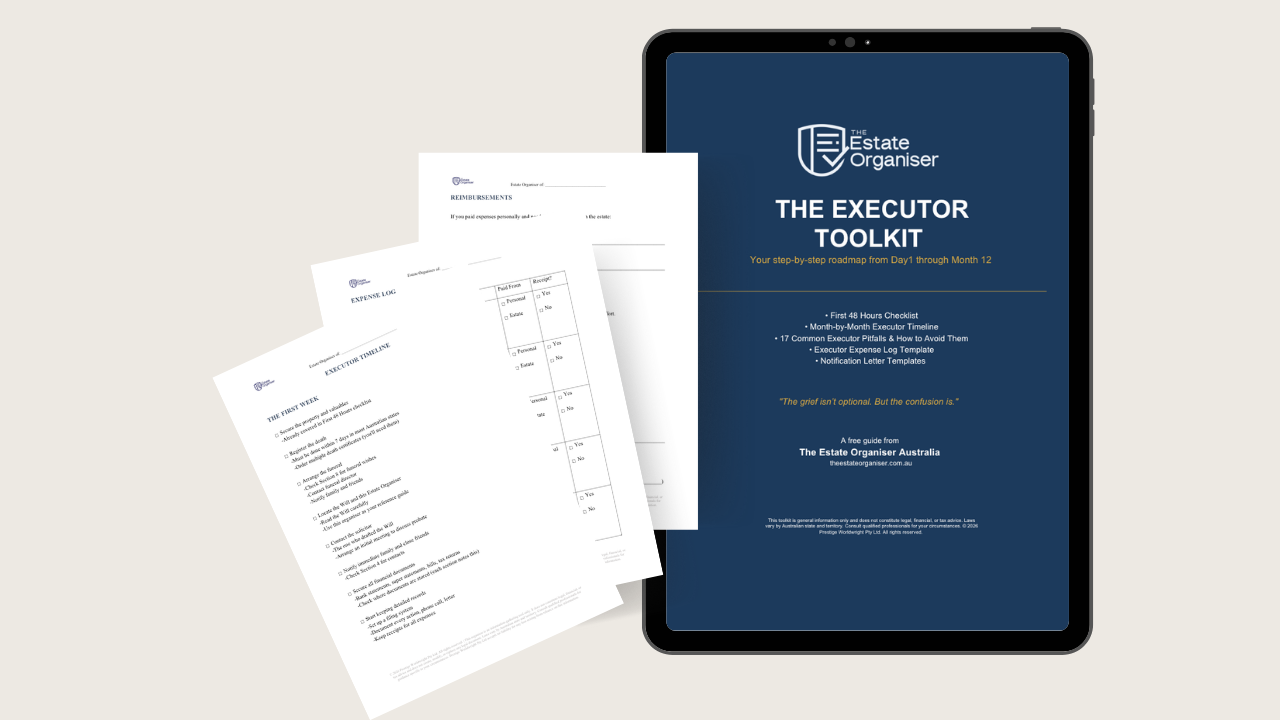
Whether you have been named an executor or you are thinking about your own affairs, the single most useful thing is a map: one document that says what exists and where to find it. That is exactly why we built the free Executor Toolkit. It is a Day 1 to Month 12 roadmap for anyone handling an estate, with notification letters and an expense tracker included.
Download the free Executor Toolkit here.
And if you would rather spare your own family the hunt one day, The Estate Organiser is the one place to record what your family will need.
Educational content only. Not legal, financial or tax advice. Estate laws vary across Australian states and territories. Always consult a qualified professional about your specific situation.
Lorem ipsum dolor sit amet, consectetur adipiscing elit. Cras sed sapien quam. Sed dapibus est id enim facilisis, at posuere turpis adipiscing. Quisque sit amet dui dui.
Stay connected with news and updates!
Join our mailing list to receive the latest news and updates from our team.
Don't worry, your information will not be shared.
We hate SPAM. We will never sell your information, for any reason.